The bit represents a logical state with one of two possible values. These values are most commonly represented as 1 and 0, but other representations such as true / false, yes / no, on / off, and + / − are also widely used.
Bits are stored in memory through the use of capacitors that hold electrical charges. The charge determines the state of each bit which, in turn, determines the bit's value. Various combinations of bits -- combinations of 0s and 1s -- are used to represent numbers larger than 1.
Sometimes abbreviated as b (lowercase), bit is short for binary digit. It's a single unit of information with a value of either 0 or 1 (off or on, false or true, low or high).
bit, in communication and information theory, a unit of information equivalent to the result of a choice between only two possible alternatives, as between 1 and 0 in the binary number system generally used in digital computers. The term is shortened from the words “binary digit.”
Bits and bytes are the smallest units of data in a computer. A bit is a single binary digit, with a value of either 0 or 1. A byte is a group of 8 bits.
A bit is considered the smallest unit of data in computing that a computer can process and store. It is short for binary digits, as it is always in one of two physical states.
A bit which is short for binary digit is the most basic form of data in a computer. It represents the smallest piece of information in a computer system, taking on one of two possible values: It can only be 0 or 1.
A bit is the smallest unit of electronic information; multiple bits form a byte. Whereas the storage capacity of hard drives is given in bytes, data transfer rates are shown in bits.
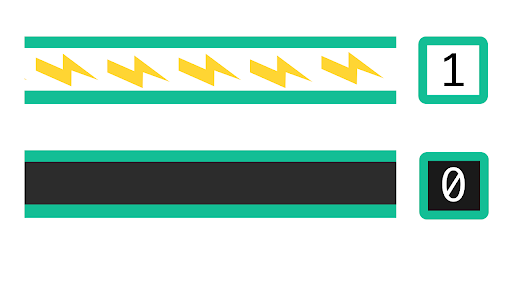 Computers store information using bits. A bit (short for "binary digit") stores either the value 0 or 1 .